> For the complete documentation index, see [llms.txt](https://en.docs.monaca.io/llms.txt). Markdown versions of documentation pages are available by appending `.md` to page URLs; this page is available as [Markdown](https://en.docs.monaca.io/products_guide/debugger/ios_simulator_build.md).
# iOS App Simulator Build
By using `Simulator Build` , you can test the application using iOS Simulator on macOS. Any Certifications, provisioning profiles, or subscriptions of the Apple Developper Program are not required for `Simulator Build` .
### Restrictions
* It is not possible to install the simulator build on any iOS devices.
* The phone hardware is unavailable in Simulator. \
For example:
* Camera
* Barcode Scanner
* NFC Reader
### Requirements
* On macOS\
The app built for Simulator works on macOS with Xcode's iOS Simulator.
* On Browser (via external web service)\
The app built for Simulator works on web service like `Appetize.io`. It does not need Simulator.
### Test on the local Simulator
1. From the Monaca Cloud IDE menu, go to **Build→Build App for iOS**. Select the `Simulator Build` option and start build.
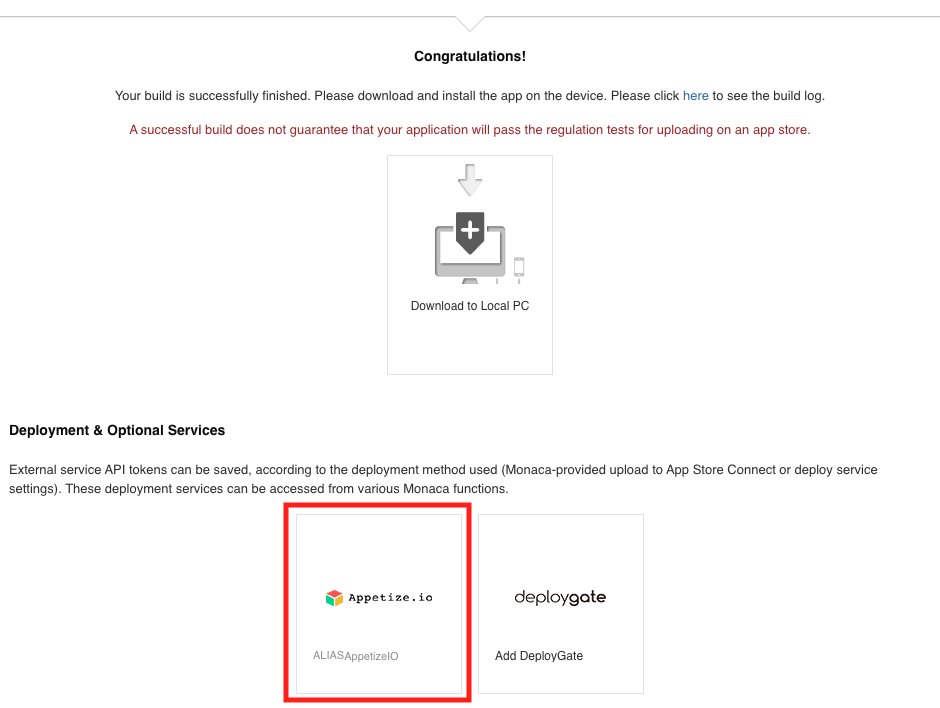
2\. After the build is completed, the `Download to Local PC` button will appear on the build result screen. \
Click the button to download the app.
3\. Extract downloaded zip file and drag & drop to Simulator.
4\. The app can run on Simulator.
### Test on Appetize.io
1. Prerequisites\
In order to use `Appetize.io`, it is necessary to register the service and configure on Monaca Cloud IDE. \
Please refer [Deploy to Appetize.io](https://ja.docs.monaca.io/products_guide/monaca_ide/monaca_ci/appetizeio) for registering `Appetize.io`.
2. From the Monaca Cloud IDE menu, go to **Build→Build App for iOS**.\
Select the `Simulator Build` option and start build.\
\
After the build is completed, the `Deployment & Optional Services` section will appear on the bottom of the build result screen. \
Select `Appetize.io`.
Click `Deploy` button and the app will be uploaded to `Appetize.io`.
3\. Sign in to `Appetize.io` and open [dashboard](https://appetize.io/apps).
You can confirm that the app from Monaca is added to `Appetize.io`.
4\. Click `view` and run the app.
The app launches and you can test your app. \
For details of `Appetize.io`, see [Appetize.io Documentation](https://docs.appetize.io/)